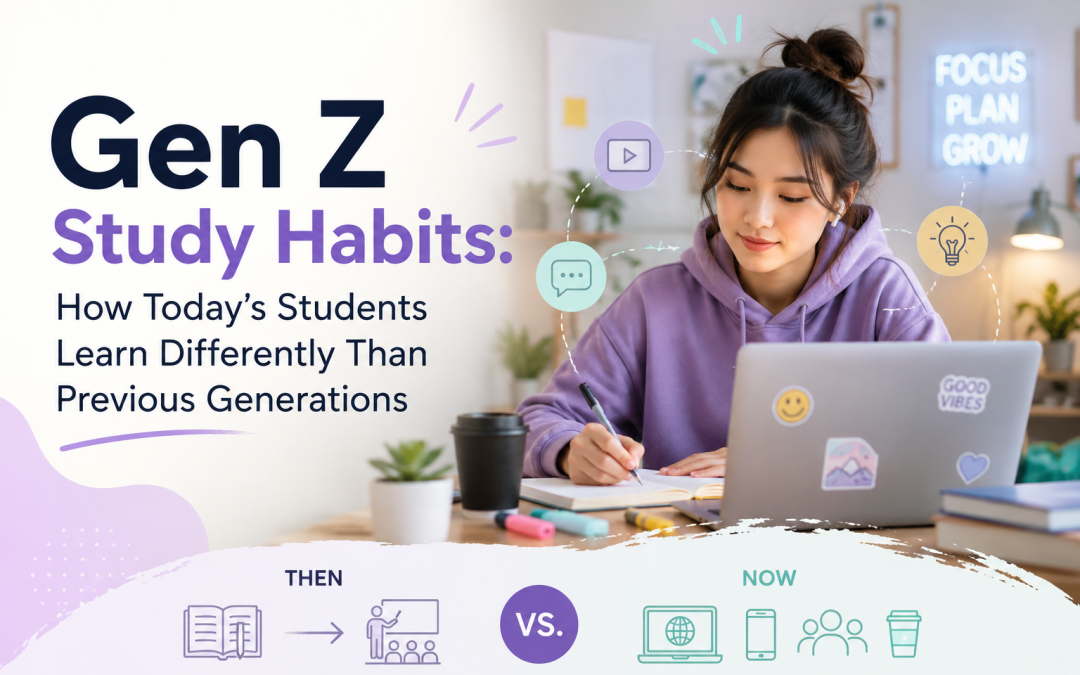
The New Era of Learning: Why Gen Z Is Redefining Education
The education landscape has undergone a dramatic transformation over the last decade, largely influenced by technology and changing student expectations. Today’s learners, commonly known as Generation Z, have grown up surrounded by smartphones, artificial intelligence, digital classrooms, and unlimited online resources. As a result, Gen Z study habits have evolved significantly compared to previous generations.
Gen Z students do not value the same flexibility, personalization and interactive learning experiences that Millennials and Generation X students value. They are no longer students only; they are not limited to textbooks or classroom lectures. However, they use digital tools, collaborative platforms, educational apps and multimedia content to enhance their knowledge of the concepts taught in school.
Knowing how these behaviors are shifting will assist educators, institutions and academic support providers in understanding and creating strategies to meet the needs of students today and to enhance academic success.
How Technology Has Completely Changed Student Learning
Technology has no longer just been an accessory to the classroom, it has become the cornerstone of education. Students can now find online libraries, educational videos, AI-based tutors, virtual classrooms and digital note taking applications.
These modern methods of learning enable learners to learn anytime, anywhere. Students have unprecedented flexibility in learning, viewing lectures on video or engaging in virtual discussion forums late at night, or in the middle of a commute.
Gen Z learners need not spend hours on the library shelves to find research materials; they can get to reliable resources within minutes. Digital accessibility has speeded up learning and promotes pupils to be more independent researchers. Students seeking academic support often choose affordable paper writing services to receive high-quality, plagiarism-free papers while staying within their budget.
Personalized Learning Experiences are on the Rise
One of the greatest changes in the education of today’s students compared to the past is the need for personalization. Each student learns in his or her own way and Gen Z has high expectations for educational materials to be flexible.
Now student learning trends and plans for study, quizzes, and revision are recommended based on performance using artificial intelligence. Students can concentrate on weaker papers as there is no wastage of their learning time on weak areas.
These individualized methods relate to current trends in student learning, which, through flexibility and customization, leads to improved student engagement.
Adaptive learning technologies are becoming more common in the realm of education, where they provide more value in terms of content delivered at the student’s pace and reduced frustration, and in terms of increased retention. Students aiming to maximize their chances of winning financial aid often turn to the best scholarship essay writing service for expert guidance and compelling, well-structured essays.
Why Digital Learning is Now Central to Student Success
Most of the previous generations depended on handwritten notes, printed books, and lectures in the classroom. These are all still useful resources, but Gen Z has added a few items to their toolkit.
Pupils regularly access video tutorials, interactive simulations, podcasts, flashcard apps, collaborative documents, and online communities to enhance learning in the classroom. There are many means of representation with these digital resources to understand challenging topics.
Long gone are the days where Gen Z’s learn by reading textbook chapters and then watching a short educational video; these two methods now increase engagement and comprehension in learning.
This visual, auditory and interactive learning allows for greater understanding and allows for the use of a variety of learning styles.
Shorter Attention Spans, Smarter Study Strategies
Students today, raised in the digital age, have different ways of consuming information. Gen Z learners do not like to read long chapters at once, but prefer to study in short periods of time, in a concentrated way.
The Pomodoro Method, micro-learning and spaced repetition are some of the time management techniques that have gained immense popularity due to their ability to focus studies and avoid mental fatigue.
The focus of these modern learning methods is quality over quantity. Students learn more efficiently by dividing the material they have to study into smaller parts and then revising material often rather than cramming it before a test.
Other fun features, such as interactive quizzes, educational games and AI-generated practice questions, keep students engaged throughout the learning process.
Social Learning is Becoming More Collaborative
Learning is no longer an individual activity. Gen Z students often work together in online discussion groups, messaging platforms, virtual classrooms, and collaborative online work spaces.
Cloud-based collaborative tools make it easier to work in groups, editing documents in real time as multiple students work from different locations.
The current tendency of students’ learning indicates that the understanding of students can be improved through the interaction between peers, so that students can discuss, share ideas and solve their problems together.
Study groups, online educational communities, social media can be used to explain challenging concepts to each other. This cooperative setting stimulates thinking as well as develops communication skills.
Mental Health Is Now Part of Academic Success
Gen Z is not afraid to acknowledge that there is a correlation between mental health and academic achievement. Pupils are becoming more aware of the importance of balancing their study and life.
Today, many students make time for themselves, practice mindfulness, regularly take exercise and have realistic academic objectives rather than studying non-stop.
The emphasis of healthy Gen Z study habits isn’t just getting good grades — it’s also about avoiding burnout and staying motivated.
Educational institutions also are increasing counseling, wellness and academic support programs to assist students in a better management of stress.
AI Becomes a Daily Study Partner
AI has revolutionized the way students do assignments, research, and study for exams. Various AI-driven tools, such as writing assistants, grammar checkers, citation generators, language translators, and tutoring systems, have emerged as valuable educational companions.
But there’s a need for responsible use of AI. These technologies have to be used by the students in order to enhance understanding and not to substitute for proper understanding.
Many contemporary learning approaches now use a mix of traditional critical thinking and AI-assisted research, offering a well-rounded learning experience and improving productivity without sacrifice in academic integrity.
AI can be used ethically to help a student organize information, to clarify more difficult concepts and to enhance the quality of writing while fostering independent learning.
What Educators Can Learn from Today’s Students
Teachers who understand changing student expectations can create more engaging classrooms. Interactive lessons, blended learning environments, multimedia presentations, and technology integration often produce higher student participation.
Instead of relying exclusively on lectures, educators are increasingly incorporating collaborative projects, case studies, virtual simulations, and real-world problem-solving activities.
These evolving student learning trends demonstrate that education is becoming more student-centered, flexible, and technology-driven than ever before.
Educational institutions that embrace innovation are better positioned to prepare students for rapidly changing workplaces where adaptability, digital literacy, and continuous learning are essential skills.
The Future of Learning Belongs to Adaptable Students
Generation Z has fundamentally reshaped the educational experience. Their preference for digital resources, personalized instruction, collaborative learning, and flexible study schedules reflects broader technological and cultural changes.
While traditional study techniques remain valuable, today’s learners benefit from combining proven academic strategies with innovative educational technologies. The future of education will likely continue evolving as artificial intelligence, immersive learning experiences, and digital collaboration become even more sophisticated.


Secure Order

Academic Assistance