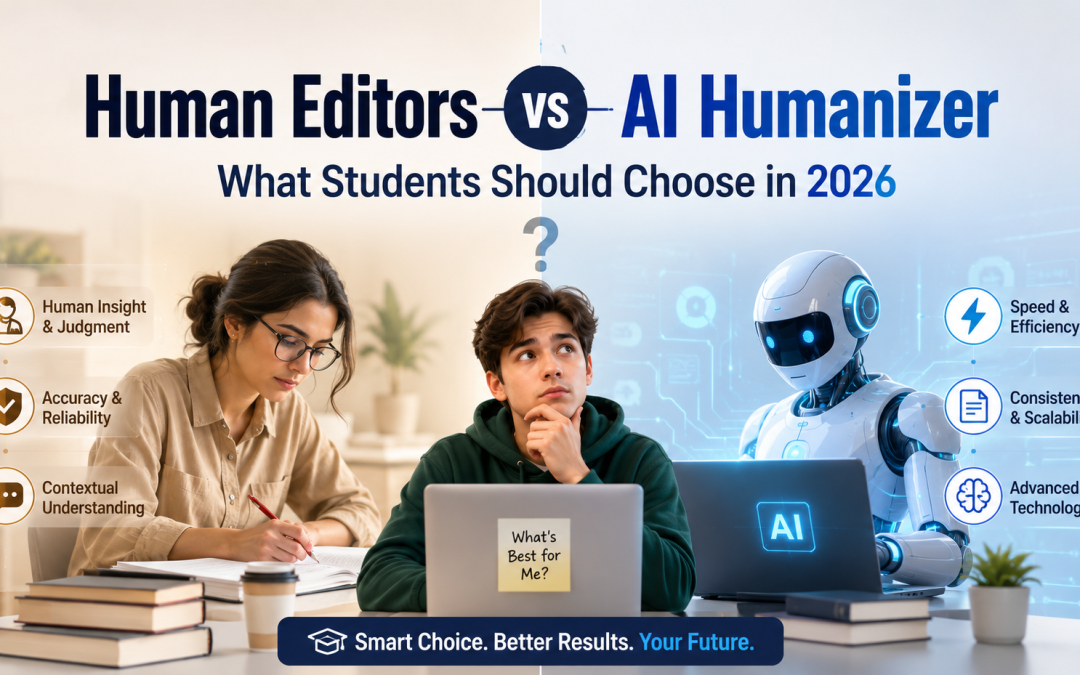
With the advent of Artificial Intelligence, writing academic papers, essays, and reports has become a breeze for students as they can do so in just a matter of minutes. Meanwhile, universities have turned increasingly to originality, critical thinking and genuine ways of academic communication. Consequently, many students are wondering in 2026: Do I have to use an AI editing tool or a real editor?
How to view the debate between human editors and AI humanizer in education has become more salient as AI-generated content to become more prevalent. Although an AI humanizer can help to improve the naturalness of AI-generated content, it is not a substitute for professional editors’ expertise, judgment, and critical thinking in some cases. It would benefit students to understand the role of human editors, as it can help them decide which way to go when it comes to creating top-notch academic papers.
Why Students Are Using AI More Than Ever
AI writing assistants are a useful study buddy. They can write outlines, summarize research, explain the more complicated ideas and even propose some amendments on grammar and sentence structure. These tools can help students save time, and alleviate writer’s block.
But, AI-generated content can be lacking in originality, critical analysis and expertise on the subject matter. In an increasingly digital world, universities are looking for students to think for themselves instead of merely writing “copy cat” papers. Therefore, the process of editing is one of the most crucial steps in the academic writing process.
Human Editors vs AI Humanizer
It’s important to know what human editors and AI humanizer have to offer when you’re considering the two.
Human editors check for grammar, sentence structure, logic, development of arguments, referencing, consistency and readability. Most importantly, they know what is expected of them in terms of context, audience and academic standards.
An AI humanizer tool, however, tends to be more geared towards making AI-generated content more conversational or natural. These tools frequently substitute the repetition of terms, change sentence structure and the style of the writing. They can help you make it easier to read, but can’t really tell you why you’re studying or how well you are doing in terms of academic arguments.
What an AI Humanizer Can Do Well
Modern AI humanizers have improved significantly in recent years. They can make robotic writing appear smoother and more engaging.
Some common benefits include:
- Improving sentence variation.
- Reducing repetitive wording.
- Making AI-generated text easier to read.
- Adjusting tone for different audiences.
- Saving time during early drafts.
An AI humanizer tool works particularly well when students already have a complete draft and simply want to improve language fluency before reviewing it themselves.
However, these tools still have limitations.
The Limitations of AI Humanizers
Although AI continues to evolve, human language involves much more than grammar and vocabulary.
AI tools often struggle with:
- Understanding subtle academic arguments.
- Evaluating research quality.
- Maintaining discipline-specific terminology.
- Identifying weak evidence.
- Improving logical flow across chapters.
- Recognizing inconsistent citations.
These limitations become particularly important when writing dissertations, research papers, systematic reviews, or literature reviews where critical thinking is essential.
The Importance of Human Editors in Academic Writing
The importance of human editors extends far beyond correcting spelling mistakes. Professional editors evaluate your work from the perspective of an experienced reader.
They examine whether your arguments are convincing, whether evidence supports your claims, and whether each section contributes to answering your research question.
Human editors can also identify unclear reasoning, repetitive ideas, missing transitions, and inconsistent terminology that automated tools frequently overlook.
Unlike software, human editors understand nuance, context, and academic expectations.
Why Universities Still Value Human Judgment
Academic institutions assess far more than grammar. Professors evaluate originality, analytical thinking, evidence, coherence, and the ability to communicate complex ideas effectively. To reduce the complexity, students can take assistance from online book report writing service for originality.
An AI-generated paragraph may appear fluent but still fail to answer the research question properly. Human editors recognize these issues because they understand educational objectives rather than simply rewriting text.
This explains why discussions around human editors vs AI humanizer continue to grow among students and educators alike.
When Should Students Use an AI Humanizer?
AI tools certainly have their place in modern education.
Students may benefit from an AI humanizer tool when:
- They need to improve readability.
- They want to simplify complex sentences.
- They are preparing an early draft.
- They need help identifying awkward phrasing.
- They want faster editing before manual revision.
- Using AI responsibly can increase productivity while allowing students to focus more attention on research and critical analysis.
When Human Editors Are the Better Choice
There are situations where professional editing provides far greater value.
Students should consider human editing for:
- Dissertations.
- Research proposals.
- Journal manuscripts.
- Scholarship applications.
- Final thesis submissions.
- Graduate school assignments.
These documents directly influence academic success and often require detailed feedback beyond what software can provide.
The importance of human editors becomes especially clear when accuracy, clarity, and academic credibility are priorities.
Combining AI and Human Editing
Students can use both technology and human expertise and not see them as competitors.
A potential process could involve initial idea generation using AI and then editing content manually. Students can then enhance the content with an AI humanizer for better readability and ask for feedback from a professional editor.
This will not only save time, but will also create a strong and authentic paper in the end.
This is a hybrid approach that is used by many successful students as it is both efficient and of quality.
Ethical Considerations in 2026
In the age of new AI policies in universities, students should be transparent in the use of AI to support their learning.
The use of AI should complement, not supplant, the process of writing. Relying heavily on automated tools could diminish the opportunities for developing critical reasoning and academic writing skills.
Professional editors also adhere to the ethical editing guidelines, refining the written material without altering the ideas or research results of the student.
By learning about responsible usage of AI, students can help uphold academic integrity during their studies.
What Option Should Students Take?
This will depend on the academic objectives you have in mind.
If you’re just looking to make your text easier to read, an AI humanizer tool might be a good place to start.
However, if you need in-depth academic feedback, logical improvements, better arguments, and polished present, professional editing is still the better investment.
The best results are typically a blend of technology and human expertise, in other words, human editors and AI humanizer.
Final Thoughts
Artificial intelligence will continue transforming education throughout 2026, but it cannot fully replace the experience, critical thinking, and contextual understanding that professional editors provide. While AI tools make writing faster and more accessible, academic excellence still depends on thoughtful analysis, originality, and effective communication. For this purpose, students should need to take some professional paper help for producing more and engaging academic writing.
The growing discussion around human editors vs AI humanizer reflects the changing nature of academic writing. Students who understand the strengths and weaknesses of each option can make smarter decisions throughout the writing process.
Ultimately, recognizing the importance of human editors while using an AI humanizer tool responsibly offers the best balance between efficiency, accuracy, and academic integrity. By combining both approaches, students can produce high-quality assignments that meet university expectations while continuing to develop valuable writing skills for future academic and professional success.


Secure Order

Academic Assistance