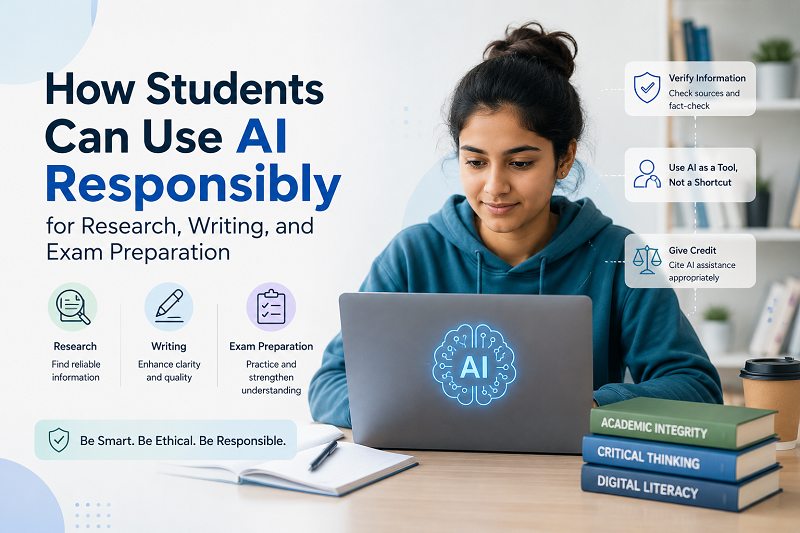
Want better grades with less stress? AI-powered learning tools are transforming the way students study, research, and succeed. AI in the field of education is a significant component in the contemporary educational landscape. Students leverage AI tools to comprehend complex concepts, structure research, enhance writing and study more effectively. The use of the AI for academic writing help should mean, however, that it serves as a tool for learning and not as a substitute for personal effort, creativity or academic honesty. When used responsibly, AI can help students save time, enhance their understanding, and boost their performance in education while adhering to ethical guidelines.
The importance of AI Responsibility in Education
AI tools can give fast explanations, summaries, examples, outlines and study plans. This can be very beneficial to the students when they are unable to cope with academic pressure. The issues come with students handing in assignments generated by AI without comprehending the material, or claiming them as their own. Learning, critical thinking and personal growth should be the basis for academic success.
This translates to the responsible use of AI in education, which is using technology as a facilitator, not an avoidance strategy. For instance, a student might prompt AI to provide a concise summary of a theory or to compose practice questions or outline an essay structure. These uses assist the student to acquire a better understanding of the subject. However, plagiarizing a full essay generated by an AI, without editing, checking, or adding original content, can have a detrimental impact on academic integrity.
How to Use ChatGPT as a Study Partner
A lot of students are now using ChatGPT for studying ethically, as it can be a personal study assistant. Can be used to explain concepts, make revision notes, produce quizzes, and practice answers. Great for students studying for tests and looking for a quick answer to difficult concepts.
For instance, a biology student can prompt ChatGPT to explain the process of photosynthesis. As a business student, one can be given examples of marketing strategies. A psychology student may request a comparison of various theories. In both, AI promotes more active student learning.
But there is a need for ethical use. Using ChatGPT to enhance comprehension, rather than cheating. It’s okay to have AI for academic writing help with practice questions and then read through the explanation. Using ChatGPT for studying ethically involves using it as a tutor rather than a replacement for the student’s work.
For law students, combining AI-powered learning tools with a law assignment helper can make challenging legal topics easier to understand and apply.
AI Support for Academic Writing
Students who don’t know how to structure, use grammar, or write in an academic style may find it challenging to complete writing assignments, essays, reports, and research papers. By providing students with suggestions on how to structure their writing, correct grammar, enhance clarity and clarity, and present ideas more effectively, AI can assist students to enhance their writing abilities.
AI for academic writing help can be a positive tool to support students’ academic writing, provided that they are actively involved in the writing process. For instance, a learner may draft a piece and then ask the AI to pinpoint any sentences that are hard to understand, arguments that are weak, or grammar mistakes. This can enhance the quality of the work and retain the student’s ideas in the process.
Preventing Plagiarism & Academic Dishonesty
Plagiarism is one of the main problems with the responsible use of AI in education. While AI-generated content isn’t necessarily plagiarized from a single source, many academic environments may still consider it dishonest to present it as if it were original. It is important for students to familiarize themselves with their institution’s policy regarding the use of AI tools for assignments before using them.
The best way is to be transparent. Students are advised to adhere to the guidelines provided by the university, if they are granted permission to use AI assistant. For example, some schools might accept brainstorming or editing with AI but not the writing of entire assignments. Others might require students to state the usage of AI.
To promote the responsible use of AI in education, students should verify information, paraphrase the information, cite their sources correctly, and not present AI-generated information as original. AI should enhance learning, rather than providing shortcuts that are detrimental to academic capabilities.
AI in Exam Preparation
AI can be a great asset for exam preparation. It can be used by students to develop revision timetables; to summarize topics; to make revision flashcards and to generate mock exam questions. These techniques can be used to enable students to revise actively instead of passively reading notes.
For instance, a student may ask AI to provide them with a week’s worth of revision schedule for their history exam or develop multiple-choice questions for a science subject. This provides students the opportunity to gain an idea about what they know and what they don’t know of the material in advance of taking the test.
When using ChatGPT for studying ethically in the preparation for the exam, it is used prior to the exam, in the preparation of practicing, revising and understanding concepts. It must never be used during the test unless explicitly permitted in the instructions for the test. Students know they have actually learned the material, which is the basis for confidence and minimizing anxiety when it comes to taking an exam.
Conclusion
AI has the potential to transform the way students research, write, and prepare for exams. It can save time, explain difficult concepts, improve writing quality, and make revision more effective. However, students must use it with honesty, awareness, and responsibility.
The best results come when students combine AI support with their own effort, research, and critical thinking. AI for academic writing help should improve clarity and structure, not replace original work. When students use AI as a learning partner rather than a shortcut, they can build stronger academic skills and prepare more confidently for future success. Students can use affordable paper writing services as a supplement to AI tools to stay on top of deadlines and improve their understanding of the subject.


Secure Order

Academic Assistance